After a night of nightclubbing in Lower Manhattan, in love with the city and the quiet it can surprisingly produce at 4AM, unexpected and dense like a blanket that fell from your mother's arms, I stumbled upon this view. It was the early 1990s and I was unstoppable. But these towers stopped me dead in my tracks with a mighty awe, these quiet mountains of glass and steel standing guard over the end of the island and my false sense of impenetrability. As will do the moon, sometimes things just look enormous in the night sky. And that night, these buildings looked bigger than my imagination. I felt so safe in their presence in a dark city that was in those days still a bit dodgy and dangerous.
Nobody ever much liked Towers One and Two of the original World Trade Center. The most that many could say of them was that they looked like the boxes the Empire State and Chrysler Buildings arrived in. But that is unfair. They were a benign presence of simple elegance and they defined our skyline for thirty-three years. Tomorrow, I'll remember the people. But thirteen years ago today was the last day of these buildings. And while I'm rather a cheerleader for the new World Trade Center in a much larger field of critics, today, I'll miss this view, the view of my youth, and miss these mountains that took me by surprise one night as we yielded to the unbearable morning, the twins who made me realize my place in the world, tiny and vulnerable, important, sure, but cut down to right size.
Willa Cather was born in Virginia but spent her formative years on the plains of Nebraska where the drama of the landscape and the pragmatism of prairie life mingled in her mind. She set out to become a physician, an unusual pursuit for a young woman at the turn of the last century, but her gifts as a writer were obvious at a young age and she switched her major to English at the University of Nebraska. After moving back east, she wrote for journals, newspapers, and magazines for ten years in Pittsburgh, PA, home to my favorite female authors, before moving and settling for the rest of her life in NYC, in Greenwich Village at the age of thirty-three. Here she wrote her masterpieces, Pulitzer Prize-winning fiction, much of it on Bank Street where you can still see her home. Her work is full of wistful romanticism flavored with an unusual economy, the hallmarks of her life in Nebraska, and while she produced quite a bit of verse, it is the free-form flowing prose-poetry I highlight here, a bit of wonder from My Antonia.
The earth was warm under me, and warm as I crumbled it through my fingers...I kept as still as I could. Nothing happened. I did not expect anything to happen. I was something that lay under the sun and felt it, like the pumpkins, and I did not want to be anything more. I was entirely happy. Perhaps we feel like that when we die and become a part of something entire, whether it is sun and air, or goodness and knowledge. At any rate, that is happiness; to be dissolved into something complete and great. When it comes to one, it comes as naturally as sleep.
Born in Joplin, Mississippi, you cannot talk of Harlem without talking of Langston Hughes. The Harlem Renaissance was nearly his invention, he certainly was its greatest voice, and he sought to give African- and Caribbean-Americans a similar voice, one without self-hatred, fear, or shame. He wrote columns, novels, and plays, but I love him for his poems, many short, some epic, all empowering. He inspired his contemporaries like Thurgood Marshall, Zora Neale Thurston, and Aaron Douglas and many foreign authors including black writers in French-speaking Africa. He discovered Alice Walker. Published often in The Crisis, the official literary magazine of the NAACP, he is most known for The Negro Speaks of Rivers, The Weary Blues, Let America be America Again, and Harlem, What Happens to a Dream Deferred? But it is the short poem below that took the wind out of my sails one day and I've never been quite the same since. It says nearly nothing, but because it is so specific, a moment we've all experienced--a poem about not having the words to write a poem--that it says everything to me, the bravery of a heart that puts a friendship in a box on a shelf because the silence is far more powerful than the poem. That is a courageous writer. And every time I encounter this piece, part of me cracks with a perfect sadness.
Edgar Allan Poe wrote the poem below at the age of twenty, upon the death of his stepmother who raised him, on the very verge of his move to New York City. Poe was a haunted man, and the deep wellsprings of his passions were tightly wound around a moroseness and longing he harnessed with the exactitude of his verse. See how he breaks up the lines here, tearing apart his own meter he had perfectly established. The effect is as isolating as his words, as isolated as his heart. Poe was born in Boston, raised in Richmond, attended UVA and West Point, wrote Israfel, To Helen, and The City in the Sea in NYC, moved to Philadelphia, and wound up wandering a street in Baltimore where he was hospitalized then died, all and by the age of forty. But not before inventing the detective novel, some precursors to science fiction, and penning some of the most widely-read better-known and hauntingly beautiful American poetry.
Alone. From childhood’s hour I have not been As others were — I have not seen As others saw — I could not bring My passions from a common spring — From the same source I have not taken My sorrow — I could not awaken My heart to joy at the same tone — And all I lov’d — I lov’d alone — Then — in my childhood — in the dawn Of a most stormy life — was drawn From ev’ry depth of good and ill The mystery which binds me still — From the torrent, or the fountain — From the red cliff of the mountain — From the sun that ’round me roll’d In its autumn tint of gold — From the lightning in the sky As it pass’d me flying by — From the thunder, and the storm — And the cloud that took the form (When the rest of Heaven was blue) Of a demon in my view —
While many places may claim her, her birthplace in Rockland, Maine, her childhood home in Camden of the same state, Poughkeepsie where she wowed them at Vassar, even Paris where she made a splash, we, here in New York, sing her praises perhaps the loudest, the city where she wandered Greenwich Village at the height of its Bohemia, and produced some of the loveliest poetry and in particular the most splendid sonnets in the English language, certainly the American canon. I love Edna St. Vincent Millay for her complicated heart. Hers was raw and fierce and brutally honest. As wonderful as life was, it was a painful affair to be sure, and as full as life was, it was unfair that it be snatched from even anyone in death. She lived by Thomas' words, raging against the dying of the light. In the poem below, she turns beauty on its head and I understand the terror of a brightness so brilliant that it blinds, the darkness in the light, an unrequited, thwarted love, the foul fairness, the poisonous libations that both beckon and maim:
When I too long have looked upon your face, Wherein for me a brightness unobscured Save by the mists of brightness has its place, And terrible beauty not to be endured, I turn away reluctant from your light, And stand irresolute, a mind undone, A silly, dazzled thing deprived of sight From having looked too long upon the sun. Then is my daily life a narrow room In which a little while, uncertainly, Surrounded by impenetrable gloom, Among familiar things grown strange to me Making my way, I pause; and feel, and hark, Till I become accustomed to the dark.
I brought my new friends to Brooklyn the other day, at the base of the Brooklyn Bridge in the shadow of two massive monuments, the bridge itself and Walt Whitman's newspaper the Brooklyn Eagle. The Fulton Ferry Landing is quiet anymore to the traffic of steamboats, but alive with New Yorkers, Americans, and international travelers longing for the view. The new fences that try to hold this humanity back from the East River are wisely adorned with Walt Whitman's words, our greatest poet I think, our American myth-maker. The myth of cities never so clearly rendered throughout the centuries, Ur, Cairo, Athens, Rome, Constantinople, have never been glorified and rarified so tenderly and courageously as Whitman tenders New York City. Read his stirring words as I did again on the fence just the other day, and get a glimpse of why we love the idea of city where every single corner and every single moment vibrates with possibility:
Flow on, river! flow with the flood-tide, and ebb with the ebb-tide! Frolic on, crested and scallop-edg’d waves! Gorgeous clouds of the sun-set! drench with your splendor me, or the men and women generations after me; Cross from shore to shore, countless crowds of passengers! Stand up, tall masts of Mannahatta!—stand up, beautiful hills of Brooklyn! Throb, baffled and curious brain! throw out questions and answers! Suspend here and everywhere, eternal float of solution! Gaze, loving and thirsting eyes, in the house, or street, or public assembly! Sound out, voices of young men! loudly and musically call me by my nighest name! Live, old life! play the part that looks back on the actor or actress! Play the old role, the role that is great or small, according as one makes it!
Glenn McDuffie, the mad bandit kisser made famous by Eisenstadt's LIFE Magazine photograph the day WWII ended has passed away at the age of 86. It was only twelve years ago that his identity was confirmed by an anthropologist who matched hundred of photos of Mr. McDuffie with the musculature and features of the man many claimed to be them.
But Mr. McDuffie gained some notoriety for his 62-year wait, and died content to know he was the man responsible for the outburst of joy that so captured the moment of the country at large, the relief that the killing would end, the spontaneous gesture of affection with which we all can identify.
He was changing trains in Times Square to meet, of all people, his girlfriend in Brooklyn. When he heard the news, he leapt out of the subway and caught the eye of the pretty nurse beaming with the same kind of explosive emotions. They locked gazes, locked lips, and locked themselves in our collective hearts for eternity.
We thank you for your service, Mr. McDuffie, we thank you for gracing Times Square with one of its most iconic moments, and we wish you bon voyage with a tear and a very fond farewell.
Many people ask me who was responsible for turning NYC around after its plunge into bankruptcy and despair, neglect and unfettered crime, a brokenness that seemed unfixable in the 1970s. There are several answers. Mayor David Dinkins took on crime like no one had before. Michael Bennett and Marvin Hamlisch wrote A CHORUS LINE and Broadway became relevant again, a must-see destination. Mayor Rudolph Giuliani implemented the Broken Window Theory and residents took pride in their own neighborhoods. And of course, as I'm always ranting, the artists invaded the neglected corners of the city and infected them with enthusiasm and joy.
This is an incomplete picture.
No one, no person, no group, no theory, no police force was more responsible for the resurrection of NYC than the man we lost today. Many years ago, Pete Seeger built a sailboat and sailed it up the river that was brown. He'd stop on shorelines and give concerts and instruct the audience that the river was our blood and we must clean it or we would not survive. So we did. And the Hudson River became clean. And the fish returned. And the city reflects the green and blue waters that now surround it. So important was this man to NYC that I propose we rename the Hudson River the Seeger River. And I propose we sing his songs today, at least once a day, forever, because no sweeter soul ever walked our streets and no kinder man ever sung about social injustice and no better man ever made our city great.
This season, stand in the middle of Bryant Park should you want to do a favor for yourself.
Walk through the fleur-de-lis golden gates and take in the oversized bronze lampposts, the balustrades separating the various plateaus, the monumental urns and ginger pots, the festooned grotto where William Cullen Bryant surveys it all, stroll past the little shops in their glass huts, the golden hues of their lights spreading out like candles in the dark, where the smiling shopkeeps sell the warmth of hot cider and cocoa and truffles and scarves, step up to the ice skating rink lit with blues and reds turning every turning skater rosy in the night, move towards the center and spin, take in the Chrysler Building, the Empire State Building, the Bank of America Tower, and the gold-leafed Bryant Park Hotel, and if you are particularly lucky, Harry Connick, Jr. will be singing And A Nightingale Sang in Berkeley Square and everybody is smiling, everybody, in love, perhaps, with each other, but most certainly, in love with the night, paying no heed to the garish sun.
The Alamo is a sculpture by Tony Rosenthal situated in the East Village at Astor Plaza very near the Cooper Union. Each side of the cube is eight feet long. Made out of steel, it is upended on an axis and, my favorite part, it spins! One person can manage it, two people can give it quite a whirl. It was erected in 1967, with a permit for a six-month exhibition. People loved it so much however, it has been spinning there for forty-seven years.
The clock in Dante Square in front of Lincoln Center was designed by one of the world's most prominent architects, a man exceedingly well represented on the NYC Skyline. His name was Philip Johnson and he gave us this clock. Across the street in the New York State Theatre, one of the thee largest stages in the Quadrangle of Lincoln Center, and designed by Johnson himself. (I have to tell you I am very fond of the building for the institutions it hosts, but it is by FAR my least favorite building at Lincoln Center and perhaps Johnson's worst design. The lobby looks exactly like a cellblock at Rikers. )(I'm told.) However, I love this sleek timepiece out front, whose four points hit north, east,south, and west.
The Dutch volunteer constabulary police force used to carry green lanterns on the ends of 'hobo poles' to make them visible on the dark night streets of New Amsterdam as they looked for 'thief's, petty larcenists, and pirates in the mid-1600s. During their breaks, they settled in the watch house and hung their lanterns outside so as not to bur the buildings down. Today, nearly every NYPD Police Precinct is adorned with green lanterns to lest you know they are 'watching and vigilant'.
One of the three massive and amazingly lifelike 'trees' in bronze, sprouting boulders in Madison Square Park in an installation titled "Ideas of Stone" by Giuseppe Penone.
What does it mean? I was asked.
Hmmm. Well. The trees are so real-looking birds have nested on them. Look! But they are leafless, uprooted and dying. Real-looking bronze. And the boulders are either floating in them or toppling the branches over. To me, they heighten the feeling of life by making it feel fleeting, temporal, precarious, a boulder in a tree, frozen in time. Stop for a moment and feel the feeling of being alive. But that's just me. (They made me smile.)
We lost Gus, the bi-polar bear, a few weeks ago at the Central Park Zoo.. He lived to be 27, but never produced any children. Known for his melancholy and obsessive-compulsive behavior, he earned one of the great nicknames in NYC History. I miss him.
The 16-foot high, 66-foot long memorial not only remembers those who died, but celebrates life for those who survived. Excerpts of 83 letters, poems and journal entries written by 65 individuals—both those who returned from the Vietnam War and those who did not—are etched into illuminated glass blocks. Alongside these personal remarks are statements by the four American presidents under whom the war in Southeast Asia was waged, and brief news clips to amplify and give context to the excerpts. Nearby, the Walk of Honor lists the names and ages of 1,741 individuals who entered the military service in NYC and were lost to the Vietnam War.
Colony Music is closing its doors and with it goes a door to my heart. My first purchase at Colony Music was G. Schirmers 24 Italian Art Songs and Arias. I was sixteen-years old and studying opera at the time and over the next ten years worked my way through the entire book which is presently in my periphery tucked underneath my piano, bound together with affection and Scotch tape. I bought the scores for La Traviata, Rigoletto, Carmen, Lucia di Lammermoor, Tosca, I Pagliacci, Madama Butterfly, and Il Trovatore at Colony. I tried my hand at musicals for a while, and bought hundreds of songs for auditions there after that. But as I couldn't dance very well, I never got really far at the dozen or so Broadway auditions I faked my way through. I still liked to sing anyway, and would browse the stacks at Colony just for the fun of it all, for the simpler joy of singing in an empty staircase or a closed rehearsal room. A few years ago, I lost the hearing in my right ear. I couldn't hear myself very well any longer. I sensed I was going wildly off key. The simpler joy was sadly slightly tarnished. So one day, I picked up a primer on the piano at Colony. My Mom had bought me a keyboard for Christmas and I taught myself some scales. More books followed and I eventually splurged on a Korg electronic piano with weighted keys. Whenever I had a hard day, I would treat myself with a trip to Colony, a three minute walk as it happens, and buy some music, my favorites like Burt Bacharach, or The Beatles, or The Complete Rogers and Hart, or something more challenging like Beethoven's Für Elise. I am not good by any measure, in any measure. At all. But it is my happiest pass-time, buying music and making music. I will miss Colony and Colony in particular. It had absolutely no pretense. It was a ratty, ramshackle, twisted, crowded, crazy affair. The owners looked as though they stepped out of an episode of Hoarders. They very well may have. The entire history of music seemed crowded into that corner of 49th Street. There was little rhyme or reason or rhythm to the stacks. But that was its great success. You could take your time in Colony and just look and listen and dig and make stunningly great finds. Every visit was a treasure hunt and the prize was the greatest music ever written. You didn't have to be a star to shop in Colony. Better put, every one was a star, every one whoever allowed music to enter into their heart was a great gleaming star in Colony and the camaraderie in the cramped aisles was the camaraderie of a galaxy: We all belong here and celebrate our own particular starshine in the collected glory of all of yours. We want the best for and from each other. Competition is as pointless as a competition of constellations. These kinds of places are disappearing all around us. And I sound old when I protest that I don't approve. But listen to your elders: Some things are worth keeping around because they make us feel better about what we can do, about what we might do, about what we dare do.
I was asked by my new friends from Kentucky what this sculpture meant. Like any good piece of art, it means some things, but anything at the same time, depending on you and how you experience it. On an as objective level as possible, it is red. A bold red cube surrounded by the black and grey and white buildings of the neighborhood. It is NOT a cube really, as it is extended on its horizontal axis making it soar upwards. It is poised on one of its corners, almost impossibly, somehow standing among all the solidly-footed skyscrapers around it. It is pierced through with a cylindrical hole.
I think of it as a big heart downtown. Something to remind us we are human, and imperfect, and bright, and driven to the impossible, and inspired to reach upwards and out of ourselves. We could fall at any moment, as the buildings in front of it, in fact, did in 2001. And although the heart is pierced, the hole, even in our frailty, still pulls our eye to our accomplishment above, to the sky.
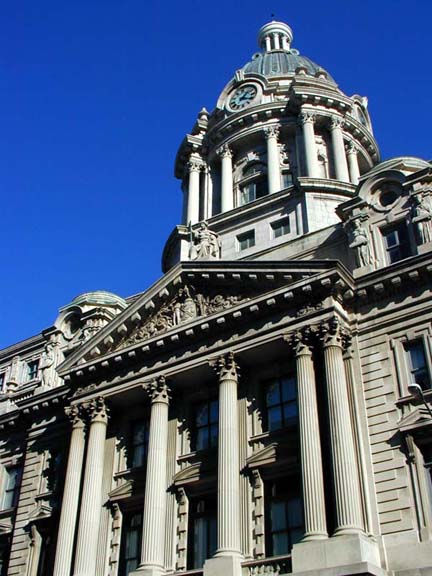
Sometimes weeks go by when I don't see this perfect gem of a building at the crossroads of no less than four different neighborhoods: SoHo, Chinatown, Little Italy and TriBeCa.
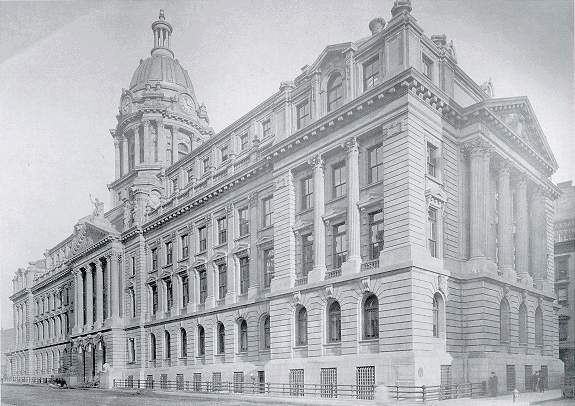
The Old Police Headquarters is a masterpiece of the drama of the Baroque and the stateliness of the Edwardian. It takes up an entire block and one must seek out a view, often hidden by surrounding subsequent buildings, of the treasure at the top: A copper-clad dome of such exquisiteness it reminds one of St. Paul's Cathedral in London or Castle Howard in Yorkshire.
The five-story limestone edifice is a feast of cornices, columns, balustrades, clock faces, finials, pillasters, but designed by the firm of Hoppin and Koen with such Palladian proportion that none of it seems overdone or out of place.
When it opened in 1909, it was meant to impress both policeman and prisoner with the majesty of the law. The basement included a pistol range. But in 1973, the NYPD moved out of the building leaving its fate in the balance. Fortunately, the Landmarks Preservation Society saved the building which was converted into 55 luxury apartments in 1987.
The last listing I saw for apartments:
2-bedroom apartment for rent at $7,000 - $11,500 per month
2-bedrooms for sale at $1,050,000 to $1,500,000
You pay for luxury, even on the corner of four neighborhoods.
One of the reasons I love living in New York City is because Leonard Bernstein lived right up the block. And right up the block they filmed the location shots for his masterpiece, WEST SIDE STORY. When WEST SIDE STORY opened, most people complained as they left the theatre that none of the songs were "hummable." What a window into how far ahead of his time the Maestro was, as it is now one of the most recognizable scores in the world.
Listen to his "Tonight":
What might have easily been a pedestrian, conventional love ballad, he underscores with breathless syncopation and our hearts flutter along as these two infatuated youngsters fall in love on a fire escape. The key shifts wildly, keeping us off balance, and each verse ends in an ominous minor key foreshadowing the star-crossed nature of a fleeting romance. It is the musical equivalent of pure joy, with the haunting notion ever present that all of this might not last or end well. Pay special attention to the young Sondheim's lyrics here. They are pitch-perfect for this song, the youth, the vigor, and the sweet, almost inarticulate ways a drop-out gang member and an immigrant dress-maker might describe their indescribable feelings. "With suns and moons all over the place." "Today, the world was just an address, a place for me to live in, no better than all right. But here you are, and what was just a world is a star."
While Bernstein was writing this score, he was simultaneously writing his opera TROUBLE IN TAHITI, a sad story loosely based on the demise of his parents' marriage.
Think of "Tonight" and all of its breathless promise, now listen to TROUBLE IN TAHITI; Scene 4 (from 0:00 to 2:40):
Achingly beautiful, about an aching subject: A duet sung apart, a couple utterly lost to themselves and to each other. Alone, together. It is a duet of regret, of pointless lies, and running through all of it is an unlikely strain of hope. I think that is what I most admire about Bernstein, that he tenders hope among the hopeless, that he tempers ecstasy with restraint if not sadness. The sweep of this score is monumental, funereal, a requiem of the highest calibre. It is almost inconceivable that Bernstein was capable of such emotional breadth during the same period in his life.
Bernstein was a deeply spiritual man, and drew from his Jewish background and his profound curiosity in Christianity to give us both the CHICHESTER PSALMS and, under commission by Jacqueline Kennedy to open the theatre in her husband's name, his MASS.
Listen to his "Adonai-ro-i:"
Bernstein's gift for melody is all over this piece. Like any good artist, especially any good artist of the late 20th Century, he understood that less is more. This is a simple melodic line rendered lush by the harmonics, and surprising by the occasional flight into the atonal. The harsh staccato section is battled into submission, bathed and washed and cleansed by the return of his stunning and now fully realized melodic line at the end.
And, out of all the transcendent music in MASS, I choose the finale for you:
It is a synthesis of all the themes he has introduced earlier in the score. It builds from the simple song we heard earlier, now sung by a boy, and builds into a canon of glory, of praise, of celebration. Allow yourself to be swept up in Bernstein's gradual rise, let your emotion soar with this score the way it inevitably will if you simply let it wash over you. And feel the enormous peace, perhaps, certainly the peace I feel every time I allow myself the privilege of listening to this.
I've written and often that Leonard Bernstein will be revered by future generations in the way we revere say, Brahms and Mahler and Stravinsky. We don't quite yet. Because he is still mortal to many of us the lucky who lived while he did. But as he passes further into the past, he will pass deeper into our collective psyches. And his music will move us in deeper ways, this man, this genius, who could score the feelings in our hearts, the specific pains and joys, the ordinary and extraordinary, and make us feel things we didn't even know we were capable of feeling.
I live down the block from where he wrote this music. And sometimes, I have to pinch myself.
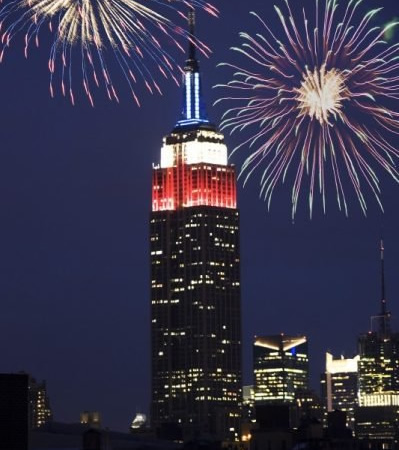
You, who dominated the skyline of the world for forty-three years, you, who are often called the most recognizable building on Earth, you, who took a punch from a plane in 1945, you, you are my champion.
I think of you gracefully tossing your crown downtown as the first World Trade Center went up forty-four years ago. You had worn it well for decades. And it was your time to sit in the shade of another building or two while still holding onto our hearts like a beloved elder-statesman.
When we watched in horror as The Twin Towers came down, perhaps our only consolation was that you, dear friend, were still safely standing up on 34th Street, and ready to bear the weight of our grief and affection, your head lit up proudly and nightly in the festive colors of the seasons, as we crowned you once again with a smaller coronet, no longer King of the World, but King of NYC most certainly, our Kong, and there you stood guarding us like a kind father while we collected our shattered selves and found the courage to reach for the sky once more.
Then yesterday, you did the extraordinary. You tossed your crown back downtown again. Who does that? Who has the humility and wisdom and graciousness to sit back in the shade twice in their lifetime? You do, my hero.
Yesterday, One World Trade Center became the tallest building in NYC, on its way up to becoming the tallest building in the United States of America. It will have its day and many more in the sun. But this week, I think of you, my forever friend, the building that tells me I'm home as it is always you, the first friend I look for whenever I return.
Thank you for carrying us through the darkness with dignity. You are our older King, but beyond that, you are our Emperor. You are the Empire State Building. And no one will ever take that from you.